Home
Home Up
Up Search
 Mail
Mail NEW
CFD meshing tests by Victor Reijs
is licensed under CC BY-NC-SA 4.0


Looking at a cubic of 10x10x10m (P(10)), tests have been held with increasing the number of mesh cells (aka decreasing the mesh-grid size).
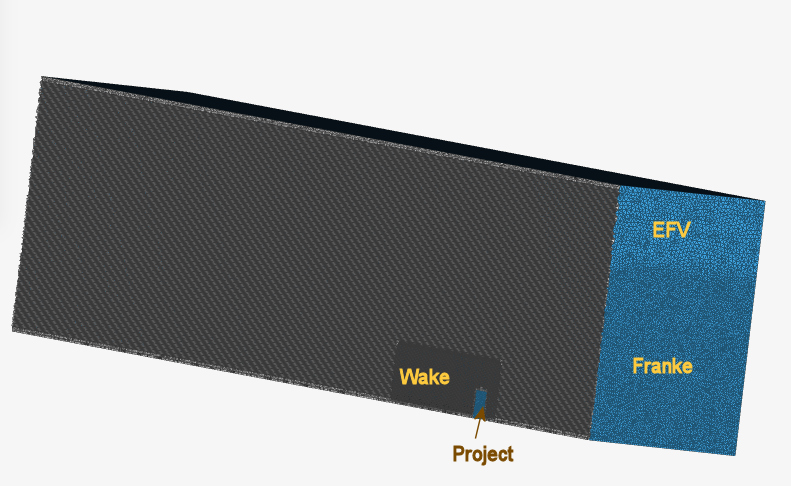
So the simulation is about a cube (10x10x1m) and it has four mesh areas:
Below is a view (through the middle of the cube) of these four
mesh areas:
In this study the 1D-size has been changed with a factor of 1.26
(see proposed by SimScale); meaning the 3D-volume changes
with a factor of 2 .
| mesh-cell size* |
mesh-name |
CPU hours (@5000iter) |
#mesh-cells [Mcell] |
Mesh-grid size [m] (F,P,W,E)** |
all IB's
1st cell height [m]***
|
Oscilatory convergence |
Smooth
probe point convergence |
| 2xminder |
211 (nl) |
33 |
4.7 |
(1.59,0.79,1.06,2.52) |
0.65 |
no |
yes |
| minder |
219 (nl) |
48 |
6.2 |
(1.26,0.63,0.84,2.00) |
0.65 | no |
yes |
| default |
209 (nl) |
148 |
7.6 |
(1.00,0.50,0.67,1.59) |
0.65 | no |
yes |
| meer |
Newmeer (nl) |
758 |
29.7 |
(0.79,0.40,0.53,1.26) |
0.65 | yes |
yes |
| 2xmeer |
211 (khairi) |
1083 |
38.1 |
(0.63,0.31,0.42,1.00) |
0.65 | yes |
yes |
| Mesh-size |
Convergence Plot - Residual |
Probe point convergence |
Relative Ux (SF)
depending on x/Hp (parameter z/Hp) |
| default |
 |
 |
 |
| meer |
 |
 |
 |
| 2xmeer |
 |
 |
 |
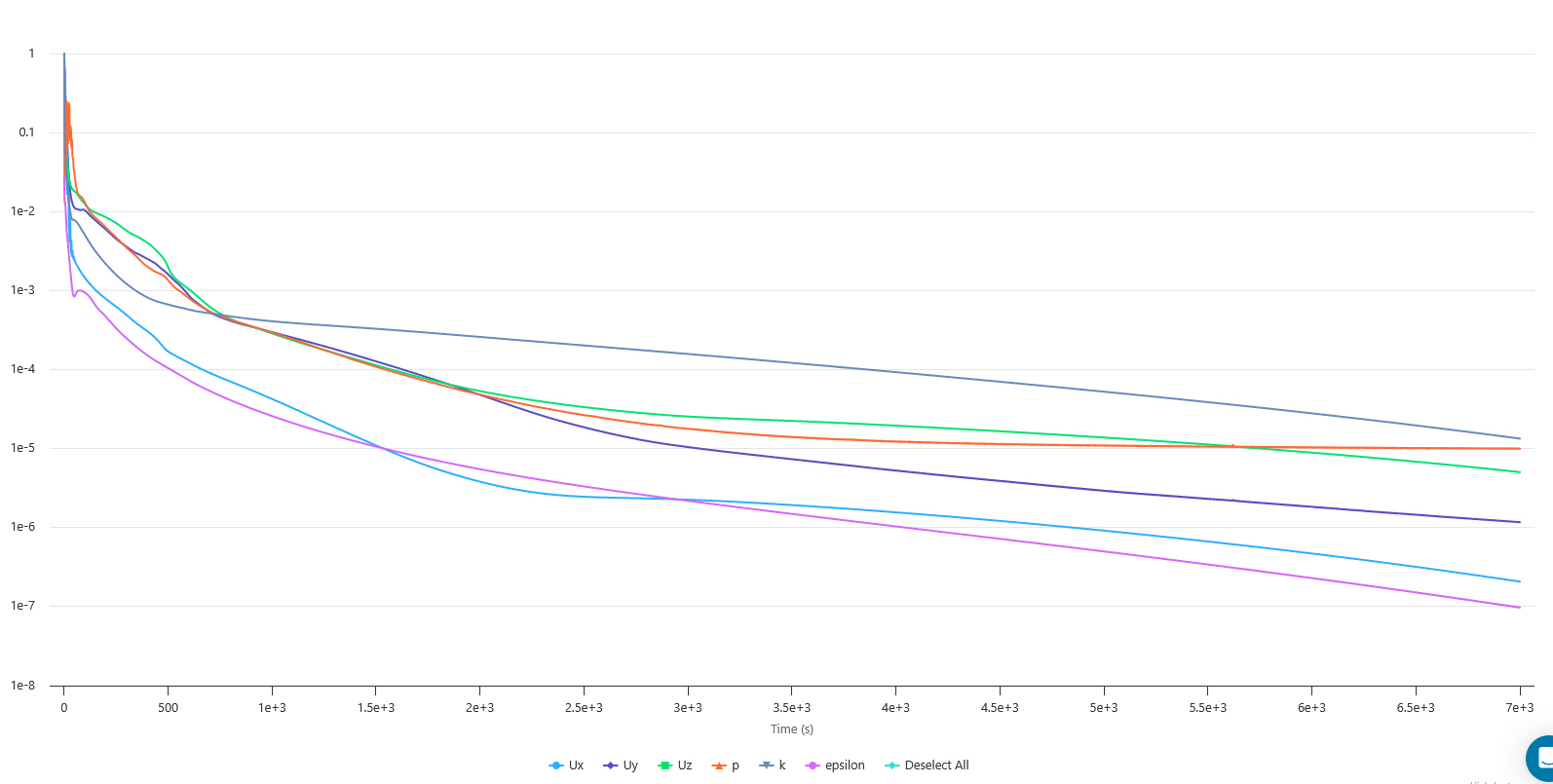
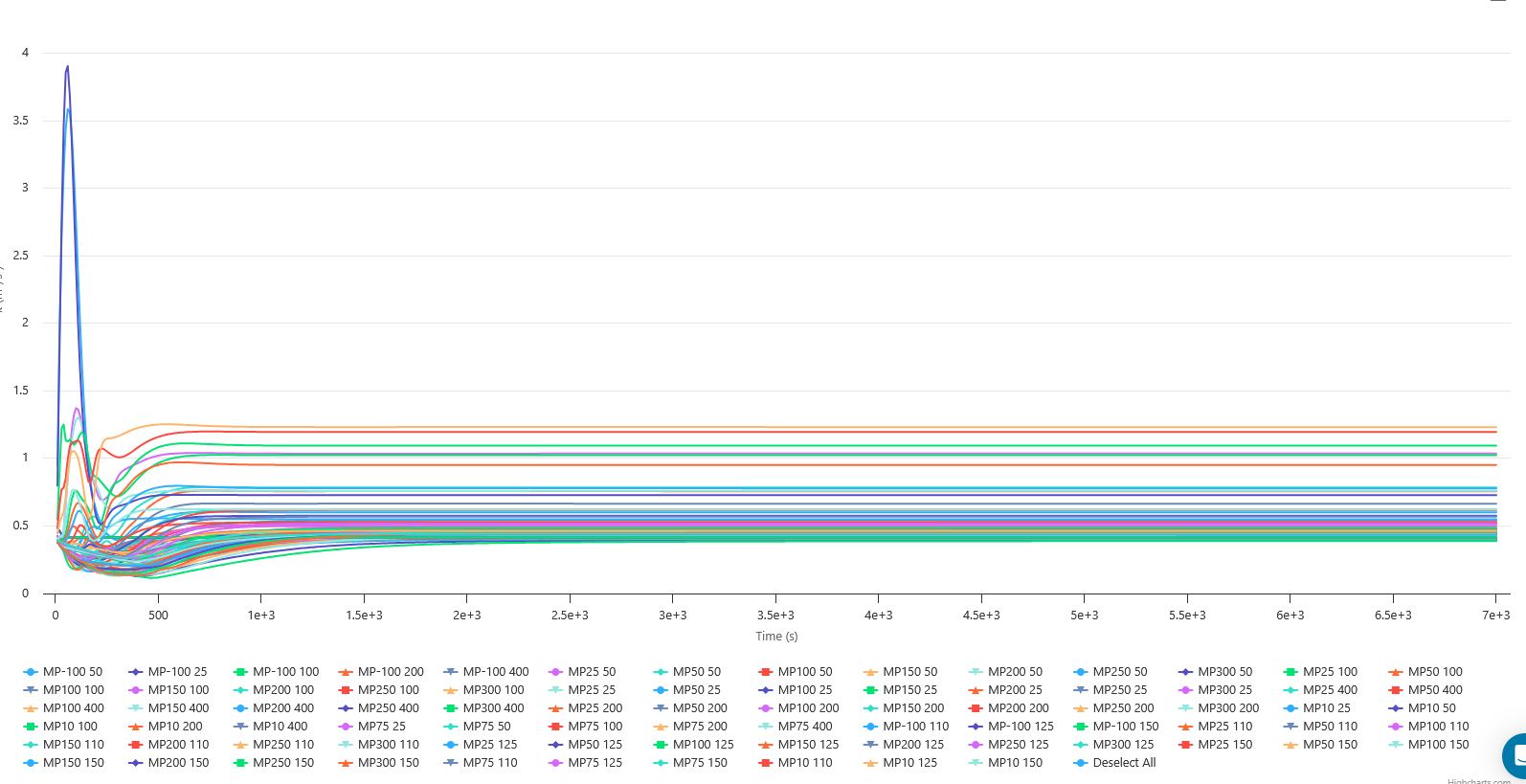
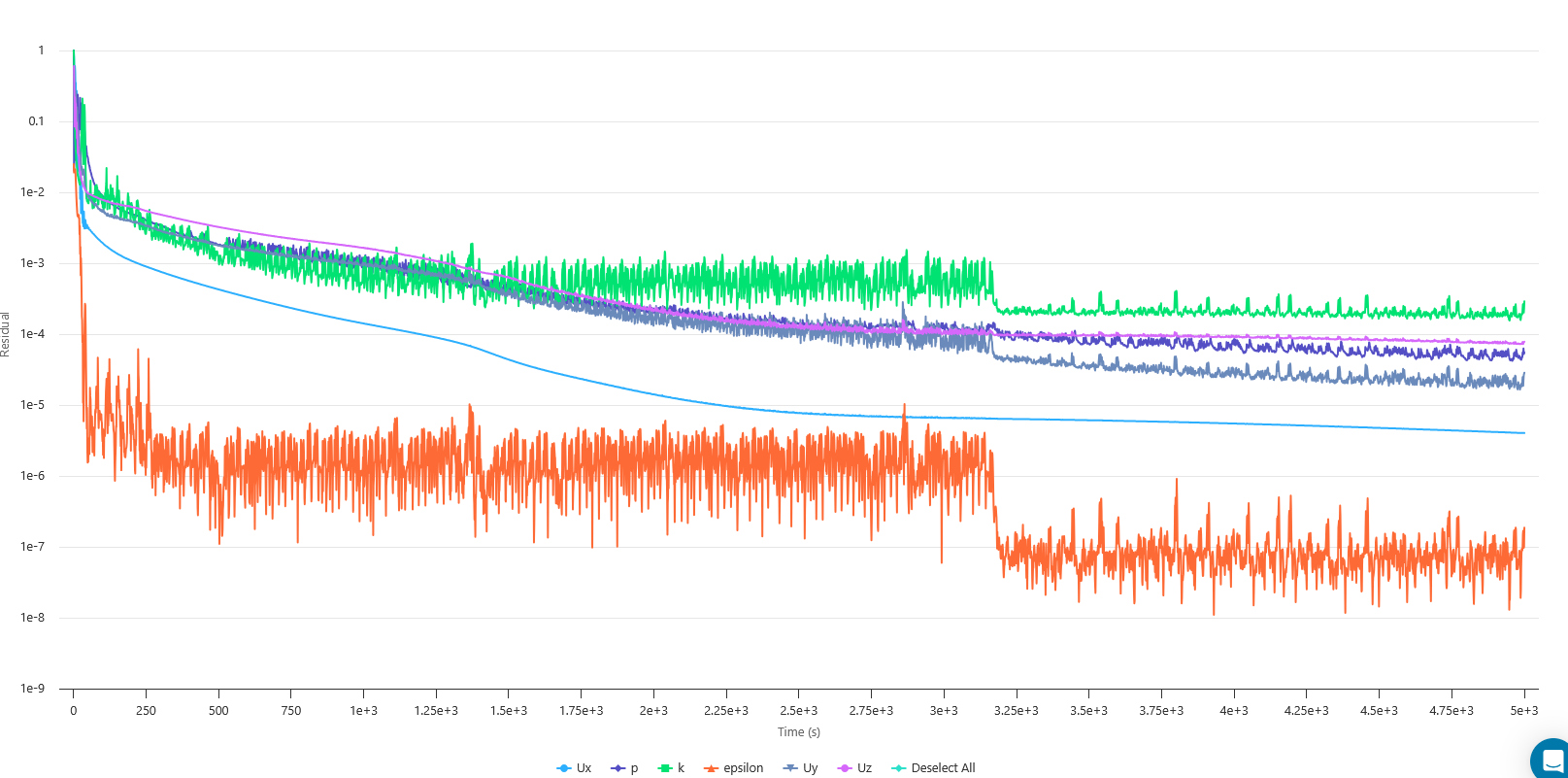
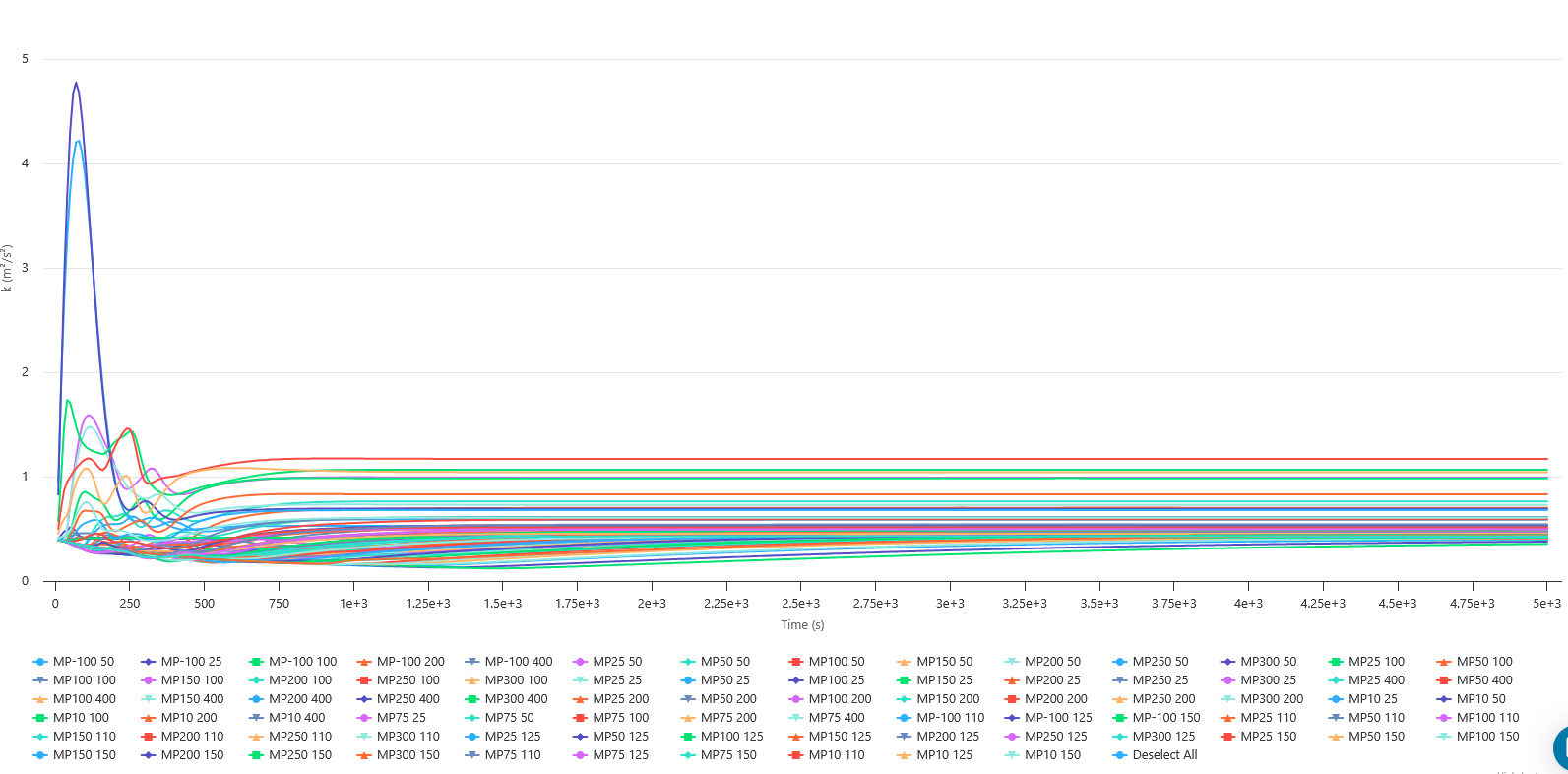
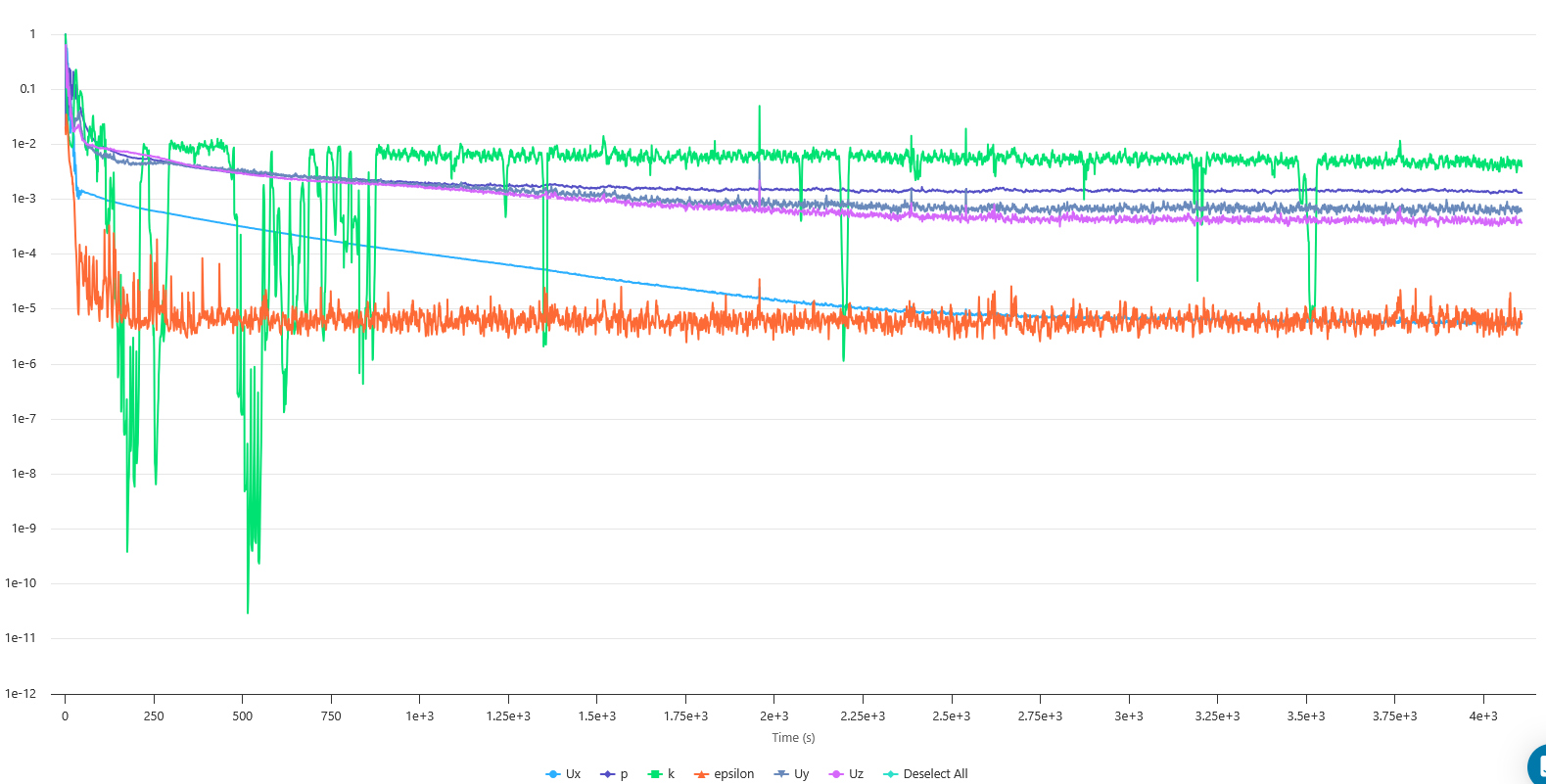
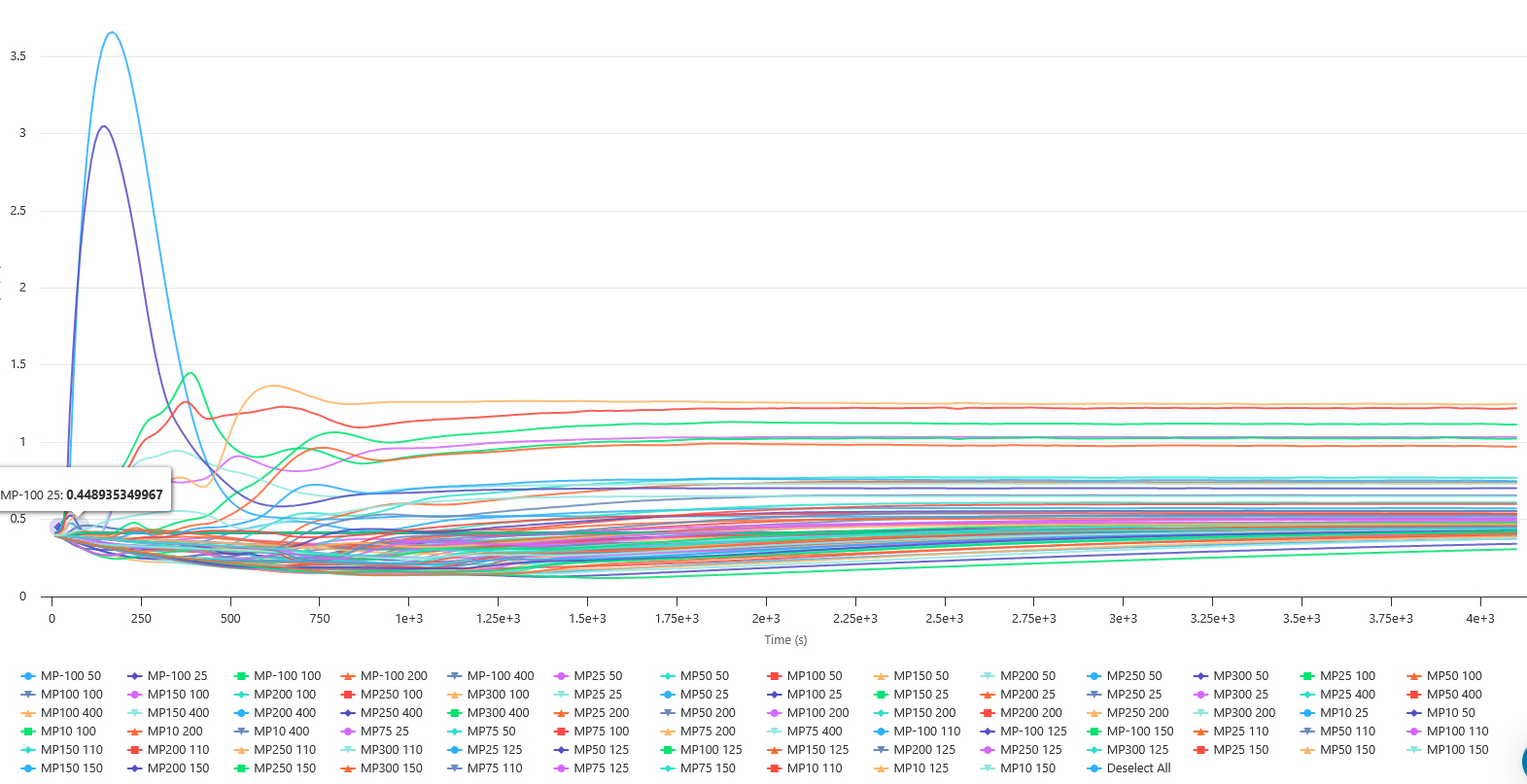
One can see oscillatory convergence of the residuals, but no
(observable) oscillation in the probe points values.
From Brocken [2015, Section 5.6]:
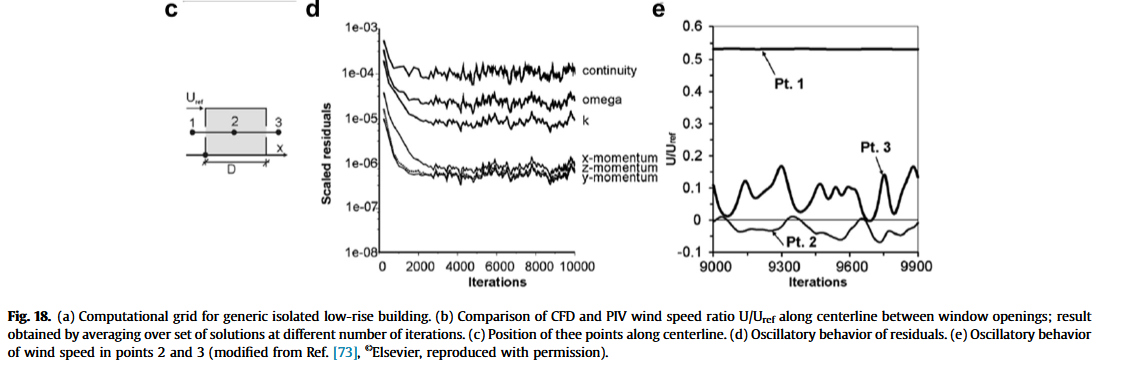
In addition to these valuable guidelines, the present paper warns for oscillatory convergence in steady RANS simulations. When flow problems that are inherently transient are forced into a steady simulation, and when numerical diffusion is limited, it is possible that oscillatory convergence occurs. This implies that not a single converged solution is obtained, but that the solution depends on the number of preceding iterations [73]. This is not an indication of a lower-quality simulation. On the contrary, it indicates that the grid resolution is high enough and numerical diffusion is low enough for non-linear effects to influence the convergence process. A detailed comparison by Ramponi and Blocken [73] of such CFD results with the high-quality Particle Image Velocimetry (PIV) measurements by Karava et al. [266] indicated that accurate results could only be obtained by averaging the CFD results over at least a period of oscillatory behavior. In addition, these simulations showed that the results at different numbers of preceding iterations corresponded to modes of the actual transient behavior of the natural ventilation flow, with a flapping jet entering the building and with signs of vortex shedding in the wake. Fig. 18 illustrates some results of this study. Fig. 18c-e shows the oscillatory behavior of the converged solution, where oscillations are found for all residuals (Fig. 18d) but not for all points in the flow field (Fig. 18e). Note that points 2 and 3, which show oscillatory convergence, belong to the regions in the actual flow field that are characterized by unsteadiness (flapping of jet in pt 2 and vortex shedding in pt 3).
The advice is to first allow convergence to continue until residuals do not change any more or enter into oscillatory convergence. In the latter case, the iterative process should be continued and solutions at different stages in this second part of the iterative process should be stored and averaged to yield the final averaged solution.
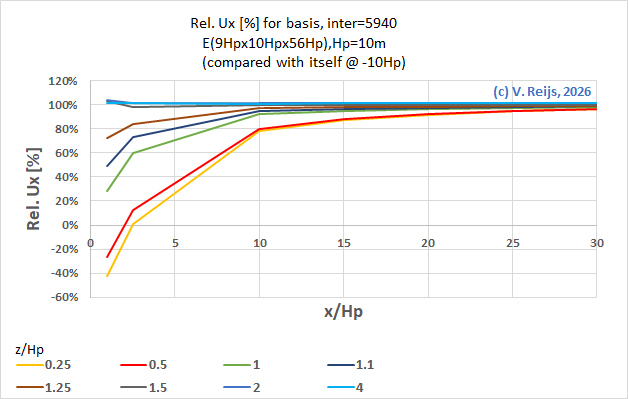
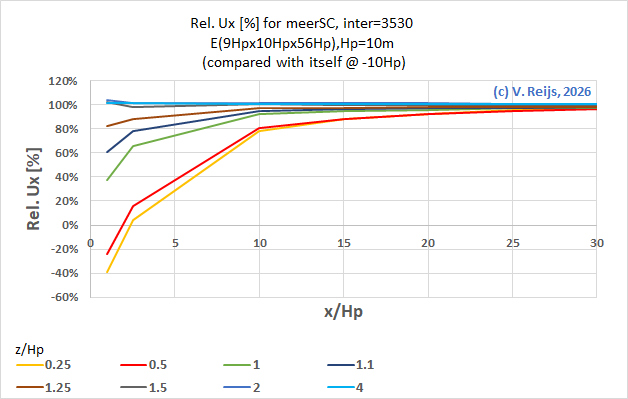
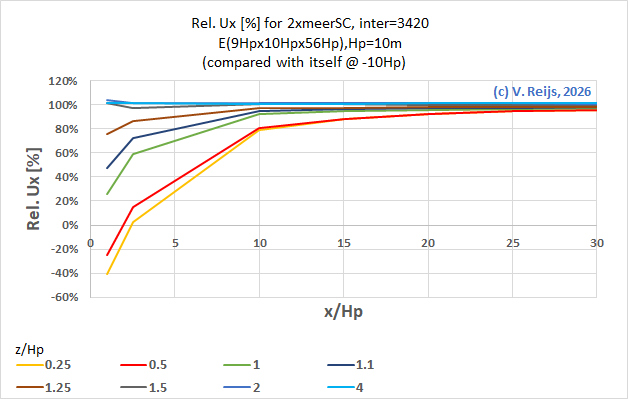
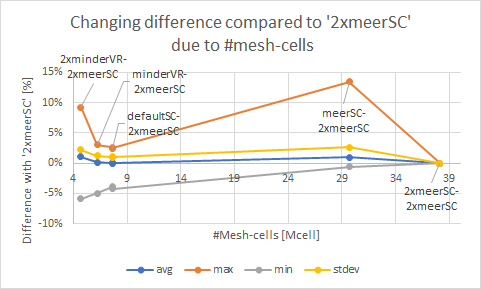
Comparing the Rel. Ux (Speed Factor SF) of the
different #mesh-cells with the Rel. Ux of
#mesh-cells 2xmeer or default, we get the
following graph:
<by the way; averaging of the Ux
[as proposed in Karava, reference by Brocken, had no significant
influence on this comparison>
 |
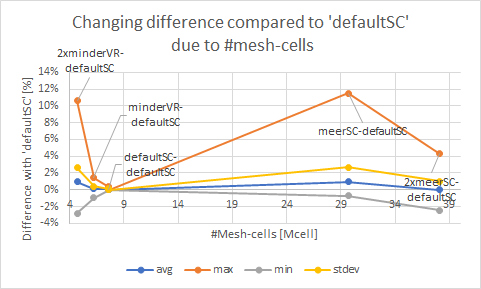 |
The form of the two graphs is similar; except the difference is
zero [of course] for the #mesh-cells compare with.
One would though expect an increasing difference between decreasing #mesh-cells. This is not happening for '2xmeer' and 'meer'.
SimScale personnel (pers. comm. 2026) provided some reasoning
behind this behavoir with regard to increase difference when
reducing the #mesh-cells:
The first three bullets sound very valid. So the chosen project
(a cube) migth not be the best to have a steady state flow (aka
using steady state simulations). As sharp edges are obviously
present with house objects, numerical diffusion (aka
demaping/viscosity, aka a large mesh-grid size) migth be a
necesary evil.
The fourth bullet around y+: It is not yet sure if this
bullet is valid for the above experiments;
as a fixed IB 1st cell height has been used of around
2*10*z0. Also in the 'meer' situaion there are no cells
that have y+ between 5 and 30, so all are outside the
buffer region.
According to Jones [2018, pape 3/6] the y+
is not very important for PWC, so it is expected to be of less
importance for traditional windmill environment:
Traditionally wall adjacent grid height requires careful tuning to retain a local Reynolds number (𝑦+) suitable for the chosen wall treatment. For buildings and structures Castro (2003) shows that wall functions have only a small effect on pedestrian wind speeds. First cell 𝑦+ criterion on buildings and structures is therefore unspecified in the AIJ and COST guidelines.
Blocken, Bert: Computational Fluid
Dynamics for urban physics: Importance, scales, possibilities,
limitations and ten tips and tricks towards accurate and
reliable simulations. In: Building and Environment 91
(2015), pp. 219-245.
Jone, Richard et al.: Guidelines for practical
application of CFD to Pedestrian Wind Environment in Australasia.
In: Nineteenth Australasian Wind Engineering Society
Workshop.2018.